
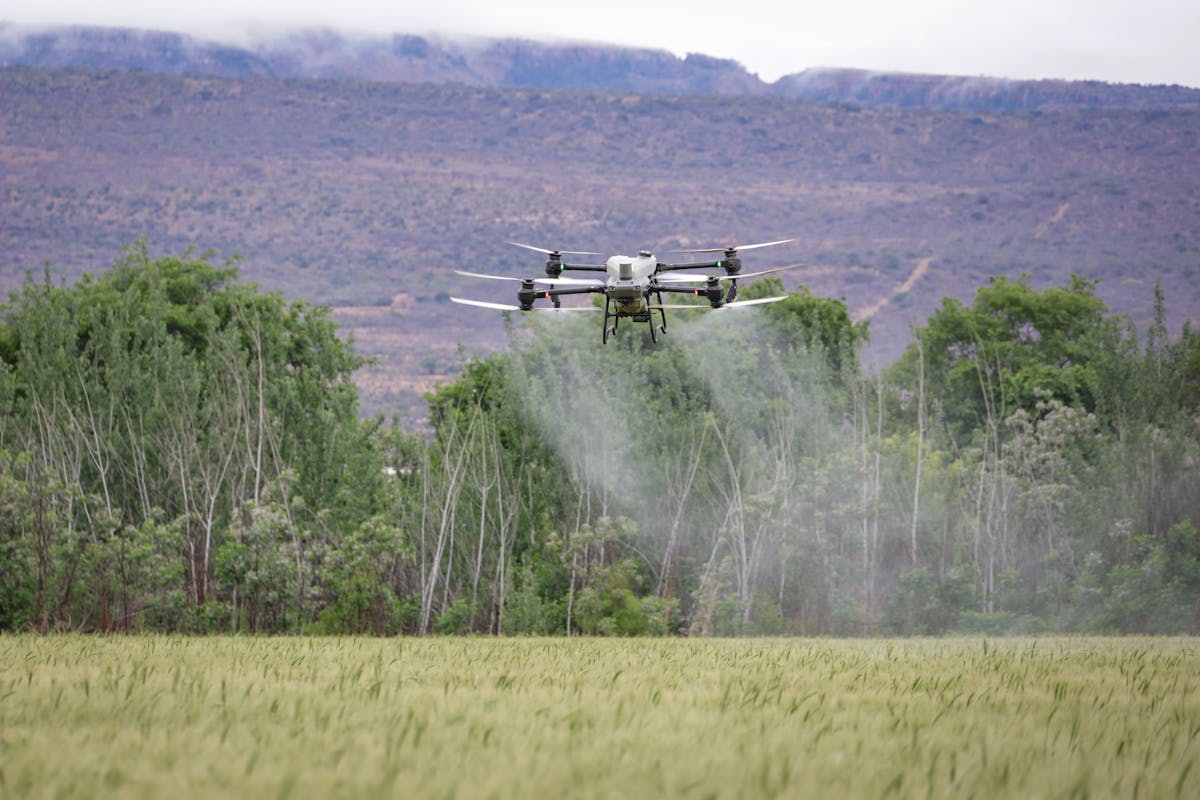
If you manage oilfield leases, pipeline rights-of-way, or industrial sites in Alberta, you already know the vegetation control headache. Woody regrowth on wellhead pads. Willows creeping into pipeline corridors. Broadleaf weeds taking over access roads. Every year it’s the same cycle: hire ground crews, send in truck sprayers or ATVs, deal with ruts, soft ground, and the inevitable spots nobody could reach.
There’s a better option now — and it’s fully legal.
What Is Garlon XRT?
Garlon XRT is a triclopyr-based herbicide (Group 4) manufactured by Corteva Agriscience. It’s been a staple in forestry and industrial vegetation management for years, primarily used to control woody plants like willow, poplar, and aspen, along with a wide range of broadleaf weeds.
What changed in July 2024: Health Canada’s Pest Management Regulatory Agency (PMRA) approved Garlon XRT for application by RPAS — that’s the regulatory term for drones. This made it the first industrial herbicide in Canada specifically cleared for drone application.
This isn’t a proposed regulation or a consultation document. It’s done. Approved. On the label.
What Does the PMRA Approval Actually Mean?
It means that drone operators with the proper certifications — Advanced RPAS Pilot Certificate from Transport Canada and a Commercial Pesticide Applicator Certificate from the relevant province — can legally apply Garlon XRT by drone on:
- Oilfield leases, wellheads, and drilling pads
- Pipeline rights-of-way
- Utility corridors and transmission lines
- Access roads and industrial properties
- Non-crop industrial areas
This is a product-specific approval on the Garlon XRT label. It’s completely separate from the broader PRO2026-01 consultation that’s been in the news around agricultural pesticides (more on that below). You don’t need to wait for any future regulation to use Garlon XRT by drone. The approval is in place right now.
Why Drones Make Sense for Oilfield and Pipeline Vegetation Control
Traditional vegetation management on oilfield leases and pipeline corridors has a list of problems that anyone in the industry knows well. Drones solve most of them.
Zero ground disturbance. This is the big one. Truck sprayers and ATVs leave ruts, compact lease pads, and cause erosion — especially in spring and early summer when the ground is soft. A drone never touches the ground. No ruts, no compaction, no reclamation headaches.
Access where trucks can’t go. Muskeg. Steep cutbanks. Narrow pipeline ROWs with no vehicle access. Flooded lease roads after spring runoff. If a drone can fly over it, it can spray it. No need to wait for the ground to dry out or build temporary access.
GPS-logged flight records. Every spray flight is recorded with GPS coordinates, application rates, timestamps, and flight paths. This gives you ready-made compliance documentation for the Alberta Energy Regulator (AER) or any environmental audit. No more estimating coverage areas or relying on hand-written logs.
Low-drift precision application. Ag drones fly at 2–3 metres above the target canopy — far lower than a helicopter or fixed-wing aircraft. Combined with downwash from the rotors pressing spray into the vegetation, this significantly reduces drift. That matters when you’re spraying a lease pad with native grass restoration 50 metres away, or a pipeline corridor next to a riparian buffer.
Photo documentation included. Before-and-after aerial photos are a natural byproduct of drone operations. You get visual proof of what was treated, when, and the condition before and after application — useful for landowner relations, regulatory compliance, and tracking treatment effectiveness season over season.
Faster coverage, lower mobilization costs. A drone operator shows up with a pickup and trailer. No heavy equipment, no boom trucks, no multi-vehicle convoys. Setup takes minutes. A high-capacity ag drone with a 70-litre tank can cover significant ground in a day, refilling from a nurse tank on the trailer. For scattered wellheads and lease sites across a field, this is far more efficient than moving ground crews from pad to pad.
What About Municipal Weed Control?
The same legal framework and technology that enables oilfield vegetation management also applies to municipal work. Counties and municipal districts dealing with noxious weed infestations in road ditches, rights-of-way, and public land can use drone application of approved products like Garlon XRT.
For rural municipalities, the advantages are similar — access to ditches and terrain that’s difficult for truck-mounted sprayers, GPS-logged records for regulatory reporting, and reduced ground disturbance on soft shoulders and drainage areas.
If you’re with a county or MD looking into this, contact us to discuss your situation.
What’s Still Coming: PRO2026-01
It’s worth understanding that the Garlon XRT approval and the broader agricultural pesticide consultation are two different things.
Garlon XRT — Approved on-label for RPAS application since July 2024. Done deal. Available now.
PRO2026-01 — This is Health Canada’s proposed regulation published February 23, 2026, which would allow drones to apply any product currently registered for conventional aerial application. If finalized, this would open up hundreds of agricultural pesticides, herbicides, and fungicides for drone spraying by default (with a registrant opt-out option). The public comment period closes March 25, 2026, and finalization is expected sometime mid-to-late 2026 — though that depends on the volume and nature of comments received.
PRO2026-01 is primarily aimed at agricultural crop spraying, but if finalized, it would also expand the list of industrial products available for drone application well beyond Garlon XRT.
For oil and gas operators, the key point is: you don’t need to wait for PRO2026-01. Garlon XRT is approved and available for drone application right now, and it handles the most common industrial vegetation management needs — woody plant control and broadleaf weed management on non-crop land.
What You Need From a Drone Spray Operator
If you’re considering drone herbicide application for your oilfield or pipeline vegetation program, here’s what your operator should have:
- Advanced RPAS Pilot Certificate — issued by Transport Canada, required for all commercial drone operations
- Commercial Pesticide Applicator Certificate — issued by the province (Alberta Environment and Protected Areas), required for anyone applying pesticide products
- Proper insurance — aviation liability and commercial general liability appropriate for industrial operations
- GPS flight logging — automated records for compliance documentation
- Local presence — someone who can respond within your operational timeline, not a crew flying in from another province
Getting Started
AgHawk Drones is based in central Alberta and provides drone herbicide application using PMRA-approved products including Garlon XRT. We hold both the Advanced RPAS Pilot Certificate and the Alberta Commercial Pesticide Applicator Certificate.
We serve the Red Deer corridor and surrounding areas — Red Deer, Lacombe, Ponoka, Wetaskiwin, Innisfail, and the rural municipalities in between. If you manage oilfield leases, pipeline corridors, or industrial sites in this area, we’d be glad to talk through your vegetation management needs and put together a quote. You can read more about our oilfield lease spraying services or go straight to requesting a quote.
Questions about Garlon XRT drone application for your sites? Get in touch — we’ll walk you through what’s possible and what it costs. No obligation.
Ready to try drone services on your farm?
Get a free quote for scouting, mapping, spreading, or thermal monitoring across central Alberta.
Request a Free Quote