
If you farm in central Alberta, you already know the drill. Spray window opens. You call the aerial applicator. They’re booked. Your ground rig is parked because the field is still too wet from last week’s rain. Meanwhile, your canola needs fungicide and the clock is ticking.
You have three options for getting crop inputs applied: ground sprayers, fixed-wing airplanes, and agricultural drones. Each has its place. Here’s an honest comparison to help you figure out which one fits your operation.
The Quick Comparison
| Factor | Ground Sprayer | Fixed-Wing Airplane | Agricultural Drone |
|---|---|---|---|
| Cost per acre | $8–$14/acre (custom) | $12–$18/acre | $16–$20/acre |
| Wet field access | Poor — ruts and compaction | Good — no ground contact | Excellent — no ground contact |
| Precision | Good with GPS guidance | Lower — higher speed, more drift | Very high — low altitude, targeted |
| Minimum acreage | Flexible | 160+ acres typical | No minimum |
| Water volume | 5–15 gal/acre | 2–5 gal/acre | 1–2 gal/acre |
| Crop damage | Tramlines, compaction | Minimal | None |
| Availability (peak) | Often your own rig | Hard to book | Flexible scheduling |
| Drift risk | Moderate | Higher (altitude + speed) | Low (flies 2–3m above crop) |
| Setup time | Quick if accessible | Needs airstrip or road | Truck and trailer, field-side |
Ground Sprayers: The Workhorse
For most Alberta grain farms, the ground sprayer is the default. You own it, you control the timing, and on a dry year it works great. Custom ground applicators run $8–$14/acre depending on the product and your location.
Where ground rigs shine:
- Large, flat, accessible fields
- Dry conditions with firm ground
- Full-season broadacre applications
- You already own the equipment
Where they struggle:
- Wet springs and falls — the biggest headache in central Alberta
- Hilly terrain around Ponoka and Innisfail
- Small or irregular fields with tight corners
- Crop damage from wheel tracks late in the season
Every farmer here has lost a spray window to mud. That’s not a knock on ground rigs. It’s just reality when you farm in an area that gets 400mm of rain a year.
Fixed-Wing Airplanes: The Big Guns
Aerial application by plane covers ground fast. A turbine Air Tractor can do 600–800 acres a day. For large-scale broadacre spraying on big fields, it’s efficient and proven.
Where planes shine:
- Large fields (quarter section and up)
- Speed — covers a lot of acres per day
- No ground compaction
- Well-established industry with experienced pilots
Where they fall short:
- Minimum acreage requirements (most operators won’t mobilize for less than a quarter section)
- Hard to book during peak spray windows — everyone calls at the same time
- Higher drift risk due to altitude and speed
- Less precise on field edges, waterways, and buffer zones
- Cost per acre adds up, especially with mobilization fees on smaller jobs
If you’re running 3,000+ acres of wheat and need a broadacre fungicide pass, calling the plane makes sense. For an 80-acre canola field with a fusarium patch in one corner, it’s not the best fit.
Agricultural Drones: Precision Where It Counts
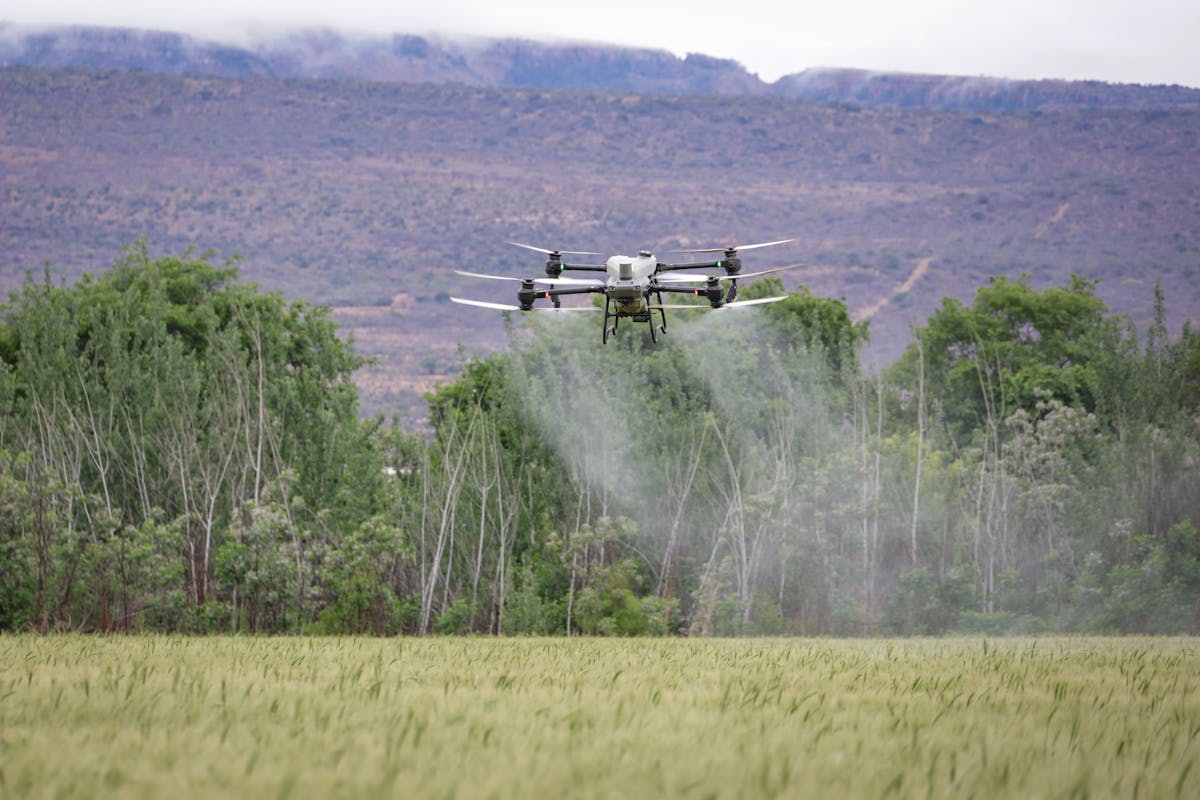
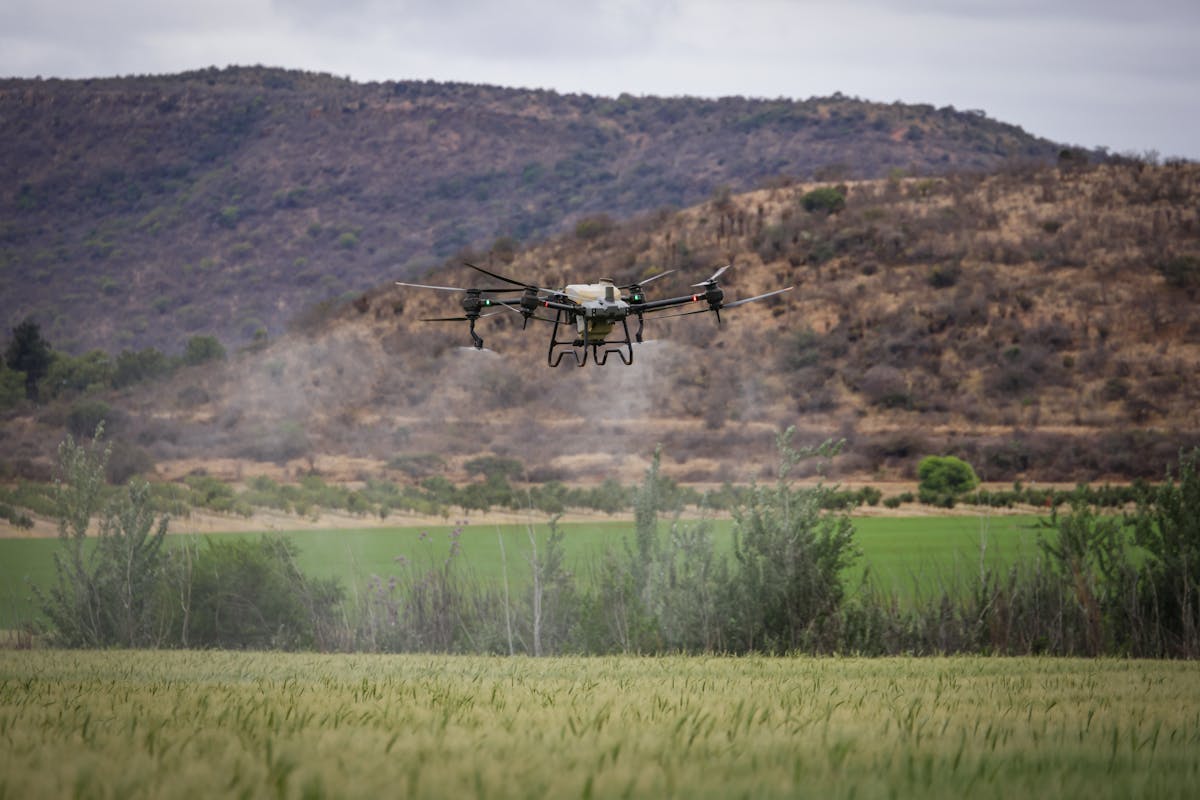
Drones are the newest option in the toolbox, and they fill a specific gap. They’re not going to replace your ground rig on 2,000 acres of flat, dry wheat. But they handle the jobs that ground rigs and planes can’t do well — or can’t do at all.
Where drones shine:
- Wet or soft fields where ground equipment gets stuck
- Spot treatments — disease patches, weed escapes, problem areas
- Small and irregular fields not worth booking a plane for
- Steep or hilly terrain
- Buffer zones and field edges requiring precision
- Late-season applications when crop is tall and ground rigs cause damage
Where they have limits:
- Full-field broadacre spraying on very large fields takes longer per acre than a plane
- Tank capacity means relay runs for big jobs (though our ag drone carries 70L per load)
- Higher cost per acre than ground spraying on easy, accessible fields
At AgHawk Drones, our high-capacity ag drone covers 60+ acres per hour for spraying, flies at 2–3 metres above the crop, and the GPS guidance keeps it within centimetres of the planned path. For spot treatments and targeted applications, the precision is hard to beat.
So Which One Should You Use?
Here’s the practical answer: use the right tool for the job.
- Dry conditions, big fields, accessible ground? Your ground rig is the most cost-effective choice.
- Large-scale broadacre pass, dry weather, quarter sections or bigger? Call the plane.
- Wet spring, can’t get the ground rig in, spray window closing? That’s where drones earn their keep.
- Spot treatment for a disease patch or weed escape? Drone. No question.
- Small or hilly field the plane won’t come out for? Drone.
Most farms will use a combination. Your ground rig handles the bulk of the work. The aerial applicator covers the big broadacre passes. And a drone service like ours handles the jobs that fall through the cracks — the wet fields, the spot treatments, the small acreages, and the tight windows.
What About Scouting First?
One thing drones do that ground rigs and planes don’t: scout your fields before spraying. With NDVI multispectral imaging, we can map your crop health at $6–$9/acre and show you exactly where problems are. That means instead of blanket spraying an entire field, you can target just the areas that need treatment.
Farmers using scout-then-spray approaches typically save 15–30% on input costs. That’s real money when fungicide is $20+ per acre.
Frequently Asked Questions
Is drone spraying more expensive than ground spraying?
Yes, on a per-acre basis for straightforward, accessible fields. Drone application runs $16–$20/acre compared to $8–$14/acre for custom ground spraying. But when your ground rig can’t get in the field, the comparison changes. A drone pass at $18/acre is a lot cheaper than a missed spray window and the yield loss that comes with it.
Can a drone cover enough acres in a day to be practical?
Our high-capacity ag drone covers 60+ acres per hour for spraying applications, with rapid battery swaps and relay runs from your field edge. For targeted spot treatments and smaller fields, throughput is excellent. For blanket spraying 2,000 acres of wheat, you’d want a plane for speed.
Will drones replace ground sprayers or airplanes?
No. Drones complement your existing application options. They’re best suited for the jobs that ground rigs and planes can’t handle well. Think of drones as another tool in the shed — not a replacement for the ones already there.
Is drone crop spraying legal in Alberta right now?
As of March 2026, full pesticide and herbicide spraying by drone is pending Health Canada regulatory approval under PRO2026-01. Approved granular spreading (fertilizer, seed, biologicals) is legal now. Scouting, mapping, and thermal monitoring are also fully legal and available. We expect full spray approval mid-2026 or later.
Farming in central Alberta around Red Deer, Lacombe, Ponoka, or Innisfail? We’re booking scouting flights and granular spreading now, with full spray services coming as soon as regulations allow. Request a free quote to see how drones fit into your operation.
Ready to try drone services on your farm?
Get a free quote for scouting, mapping, spreading, or thermal monitoring across central Alberta.
Request a Free Quote